
Salt-Free vs. Salt-Based Water Softeners: Which Is Right for Your Home?
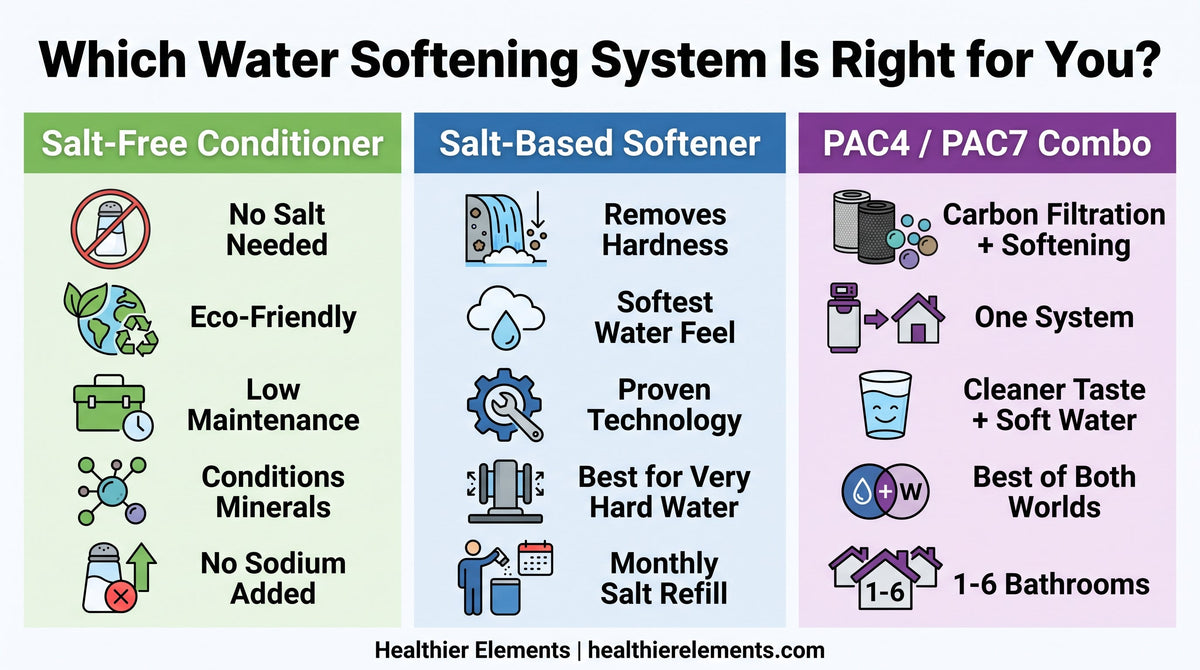
Hard water is one of the most common household water problems in the United States. It leaves scale buildup on fixtures, makes soap less effective, dries out skin and hair, and shortens the lifespan of appliances and plumbing. If you're researching solutions, you've probably come across two main options: salt-based water softeners and salt-free water conditioners.
They sound similar, but they work very differently — and both are legitimate, effective solutions depending on your situation. Here's an honest breakdown of each so you can make the right call for your home.
What Is Hard Water?
Hard water contains elevated levels of dissolved minerals — primarily calcium and magnesium. These minerals are harmless to drink, but they cause real problems around the house:
- White scale buildup on faucets, showerheads, and appliances
- Soap that doesn't lather well and leaves residue
- Dry, itchy skin and dull hair after showering
- Reduced efficiency and lifespan of water heaters, dishwashers, and washing machines
- Spotted dishes and glassware
Both salt-based and salt-free systems address hard water — but in different ways, and each has real advantages depending on your home and preferences.
How Salt-Based Water Softeners Work
Salt-based softeners use a process called ion exchange. Hard water passes through a resin tank filled with sodium-charged beads. The calcium and magnesium ions swap places with sodium ions, effectively removing hardness minerals from the water entirely.
The result is genuinely "soft" water — water that contains no hardness minerals at all. It's the most thorough solution for hard water and has been the gold standard in home water treatment for decades.
Pros:
- ✅ Completely removes hardness minerals
- ✅ Eliminates scale buildup entirely
- ✅ Noticeably softer feel on skin and hair
- ✅ Most effective solution for very hard water
- ✅ Proven technology used in millions of homes
Cons:
- ❌ Requires regular salt refills (monthly maintenance)
- ❌ Adds a small amount of sodium to your water
- ❌ Restricted or banned in some municipalities
How Salt-Free Water Conditioners Work
Salt-free conditioners use a process called Template Assisted Crystallization (TAC), also known as Scale Stop technology. Instead of removing hardness minerals, the media transforms them into microscopic crystals that can't stick to surfaces.
The minerals are still present in your water, but they pass through harmlessly without forming scale on your pipes, fixtures, or appliances. It's a low-maintenance, eco-friendly approach that works well for many households.
Pros:
- ✅ No salt, no chemicals, no electricity
- ✅ Zero water waste — no regeneration cycle
- ✅ Low maintenance — media lasts years before needing replacement
- ✅ Environmentally friendly
- ✅ Doesn't add sodium to your water
Cons:
- ❌ Does not fully remove hardness minerals
- ❌ Water won't have the "slippery" feel of fully softened water
- ❌ Less effective at extremely high hardness levels
Side-by-Side Comparison
| Feature | Salt-Based Softener | Salt-Free Conditioner |
|---|---|---|
| Removes hardness minerals | ✅ Yes | ❌ No (conditions them) |
| Prevents scale buildup | ✅ Yes | ✅ Yes |
| Requires salt | ✅ Monthly | ❌ Never |
| Uses electricity | ✅ Yes | ❌ No |
| Wastes water | ✅ Yes (regeneration) | ❌ No |
| Adds sodium to water | ✅ Small amount | ❌ No |
| Maintenance | Monthly salt refills | Media replacement every few years |
| Eco-friendly | ❌ No | ✅ Yes |
| Restricted in some areas | ✅ Some states/cities | ❌ No |
Which One Is Right for You?
Honestly — both are excellent systems. The right choice comes down to your water hardness level, your lifestyle, and your personal preferences. Neither is universally "better." They just solve the problem differently.
Salt-Based Is a Great Fit If:
- Your water hardness is very high (above 25 GPG)
- You want hardness minerals completely removed
- You love the feel of fully softened water on your skin and hair
- You don't mind the monthly maintenance of adding salt
- Salt-based systems are not restricted in your area
Salt-Free Is a Great Fit If:
- You want low-maintenance, eco-friendly water treatment
- You're on a low-sodium diet or prefer no additives in your water
- Salt-based softeners are restricted in your area
- You want scale protection without the ongoing cost of salt
- You already have a whole house carbon filter and want to add scale protection
Want the Best of Both Worlds? The PAC4 and PAC7
If you want carbon filtration AND salt-based softening in a single system, the Pentair PAC4 and PAC7 are built exactly for that.
These combo systems combine:
- Activated carbon filtration — reduces chlorine taste, odor, chemicals, and VOCs
- Salt-based water softening — removes hardness minerals completely
You get cleaner, better-tasting water AND genuinely soft water from every tap — without needing two separate systems installed side by side.
| PAC4 | PAC7 | |
|---|---|---|
| Best For | 1–3 bathrooms | 4–6 bathrooms |
| Carbon Media | 1.5 cubic feet | 2.0 cubic feet |
| Softening Capacity | ~46,000 grains | ~61,000 grains |
| Price | $3,499 | $3,999 |
Both include the carbon tank, softener tank, brine tank, control valves, sediment filter, bypass valves, and installation guides — everything you need in one shipment with free freight delivery.
The Pentair Pelican Salt-Free Option: NaturSoft NS3 and NS6
If you prefer the salt-free route, the Pentair Pelican NaturSoft NS3 and NS6 use Scale Stop media to prevent scale buildup throughout your entire home — with zero salt, zero electricity, and zero water waste.
- NS3 — designed for homes with 1–3 bathrooms
- NS6 — designed for homes with 4–6 bathrooms
Both pair perfectly with the Pelican PC600 or PC1000 whole house carbon filter for complete whole-home water treatment.
Already have an NS3 or NS6 installed and need to refresh the media?
Frequently Asked Questions
Does a salt-free conditioner make water feel soft? Not in the same way a salt-based softener does. Salt-free conditioners prevent scale and protect your plumbing, but the water won't have the same "slippery" feel that fully softened water has. Many homeowners find this a worthwhile trade-off for the lower maintenance and eco-friendly operation — but if that soft-water feel is important to you, a salt-based system or the PAC combo is the better choice.
Is salt-based softened water safe to drink? Yes. The amount of sodium added by a salt-based softener is small and considered safe for most people. If you're on a strict low-sodium diet, consult your doctor — or consider a salt-free conditioner instead.
Can I use a salt-free conditioner with my existing Pelican carbon filter? Absolutely. The Pelican NS3 and NS6 are designed to work alongside the PC600 and PC1000 carbon filters as a complete two-system whole-home water treatment setup.
What if I want carbon filtration AND salt-based softening? That's exactly what the PAC4 and PAC7 combo systems are built for — one complete system that handles both.
Ready to Shop? We Carry All Options.
Not sure which is right for your water? Text or call us — we'll help you choose based on your actual water hardness and home size. We specialize exclusively in Pentair and Pelican systems, so you'll get a straight answer, not a sales pitch.
👉 Salt-Free Conditioner — NaturSoft NS3 (1–3 Bath)
👉 Salt-Free Conditioner — NaturSoft NS6 (4–6 Bath)